

The last 30 days have blown by me! Even with the greatest intentions, I have failed to continue putting out any information regarding this year’s corn crop. March and April went by so fast; it was a blur. I guess that’s what happens as you get older.
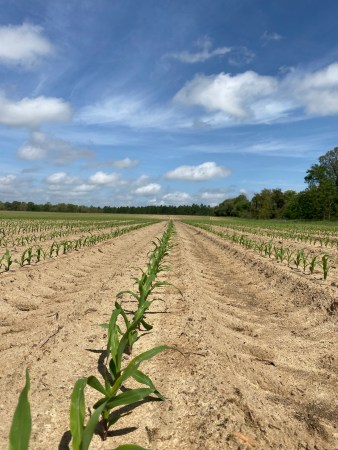
What is the state of Georgia’s corn crop? Overall, weather has been conducive for reasonable planting conditions throughout the state. Of course, there have been some drier areas but we’ve received enough rainfall to keep the crop moving forward. Corn planting is still occurring in north Georgia. I am seeing crop stands from V4 in north Georgia to V11 in some of the earliest plantings in the southern portion. There is a lot in the V7 to V9 stage.
This week’s USDA-NASS crop report showed 81% of the expected corn acreage in Georgia has been planted (right at the five-year average). South Georgia counties are experiencing doughtier conditions but also have been subjected to unexpected hail damage lately. Given the current rapidly moving weather fronts, I’m not surprised. If the current forecast holds, some areas in north Georgia may get enough rainfall to finish out their planned crop. Growers with irrigation will have to water earlier than desired to keep up with rapidly accumulating growing degree units.
Unfortunately, I recognize that all fields were not tested for nematode problems or soil tested to know what nutrients you have available (good or bad); and, that you are ready to prescribe an exact formula of nutrients, biostimulants, herbicides, etc. to every field. I expect most are just trying to get the best return on the input investment (ROI) that you can get, given the price of corn and cost of inputs. (I am glad to see prices improve a little). There are some time tables or time points that are very important in developing a healthy plant that has the best potential to return that ROI given a reasonably good season. I encourage you the read if you are interested in it, the 2024 Georgia’s Corn Production Guide https://grains.caes.uga.edu/content/dam/caes-subsite/grains/docs/corn/2024-Corn-Production-Guide.pdf . Please look at the Corn Growth & Development chapter for a quick review on growing degree units and corn growth stages. I encourage you to keep detail notes on your inputs by growing degree days. This will be easier for you to repeat success in the future or change your timing of inputs as you learn what works and doesn’t work for your production practices and your farm. Also, Iowa State University has an excellent publication (https://store.extension.iastate.edu/Product/Corn-Growth-and-Development). It is a good tool to have to understand the development of your corn crop. It is worth the money.
Fields plagued with nematodes have already lost yield potential and will require careful attention to focus on achieving a lower but economical yield potential. It will be very important to foliar feed the crop while roots recover from the stress and produce more roots. Warming temperatures, and bright sunny day along with ample irrigation can help the plant focus on using carbohydrates (plant food) to recover from the lack of roots. Tissue analysis can get you a snap shot of the nutrient analysis of the plant as it enters a very rapid growing phase. Any nutrient that is not in a sufficient range for ample growth will need immediate attention. Quite honestly, if you partition nutrients out over time via irrigation, you will maintain nutrients so much better that relying on our sandy soils to maintain nutrients that can readily leach with rainfall.

Corn that is entering into the V4 to V5 stage is starting a transition from vegetative production to a reproductive phase of creating a tassel and ear primordia (the meristematic cells of developing ears). If you have 75+ units of N with a large portion near the row you should be on target for additional N now. Stress in this phase reduces dry matter production, slows the plant development, and undermines the number of rows on a cob thereby, reduces the yield potential. Make sure that you don’t get behind on side dressing your corn crop and add nutrients near the row i.e. Y drops, etc. or via your irrigation system. Make sure you have that early tissue analysis on hand to correct any nutrients that have fallen below sufficiency levels or are out of balance with other nutrients.
More and more growers are looking at why they are having difficulty breaking through their own farm barriers from year to year. There can be lots of reasons (large or small) behind this. You might want to experiment a little with a smaller field that has always had good yield potential. Start with one or no more than two products outside your normal production system. Make sure to leave test strips for your checks. If you are putting them through your pivot, leave out half just to check. There are lots of different products: i.e. bio-stimulants, plant growth regulators, microbial mixtures, specific types of sugars, humic or fulvic acids, stress mitigators, bio-fertilizers, more expensive but improved fertilizers with lower salt index and greater solubility. Start slow but be persistent. It’s not a one and done thing.
Corn moving past V7 to V9 has entered a rapid growth phase. If you are irrigating, this is a must time to partition a portion of your N supply out in 40 lbs per acre increments through the pivot. IF you are a dryland grower, I would finish up by V7 unless I could drop fertilizer by the row. Broadcasting will certainly burn tissue that catches fertilizer granules but yield loss is worse from nutrient deficiency than burning the tissue.
It helps also helps to monitor with frequent tissue analysis to ensure all nutrients are in balance and none are lacking. Throughout this phase the numbers of kernels along the row are being set and total dry matter production (stalk and leaves) will be the factory that will sustain carbohydrate movement during the early kernel development phase after pollination. Usually by the V15-V16 stage, 25 to 30% of the total dry matter has accumulated. Keep a watchful eye for foliar diseases and do not be afraid to use a good fungicide to protect your crop.

Dryland growers should also keep an eye out for diseases prior to tasseling. If you have a good crop, that last input can make that profit that you need as disease pressure builds. Those 18-20 days from silking forward are extremely important to prevent kernels from aborting and reaching a reasonable size and yield potential. Corn is resilient if the stalks maintain good health during R1 to R3 phase.
As always, let’s pray for good weather and bright sunshine, the two things we can’t do anything about in our corn crop.
 Georgia Corn Growers Blog