

Looking back at previous years’ temperatures and rainfall during the month of March, 2024 is progressing similar to 2023 and 2022. Temperatures in March 2021 were cooler and growing degree accumulation in corn was slower than the other years. Looking back over a decade, our 2024 start (like the last two years) has been at a slightly slower pace. While looking at our current situation, many corn growers have already planted, yet there have been some delays in some areas due intermittent rain showers. While stating the obvious to you, I want to remind everyone there is plenty of time to plant a corn crop and still have good yields at the end of the season as long as we continue these average rain showers and reasonably good weather. That is good news and encouraging to all that a good foundation is being laid down for you to capture as much yield potential as possible. There has been a little less solar radiation due to a few more cloudier days than the previous years, but growing degree units are steadily pushing the crop forward.
The most disturbing problem for corn in 2024 is not the environment but the price. Markets dropped in late Feb to near $4.00 per bushel. It’s been quite some time since we’ve seen these low prices around the world. Prior to late Feb, $ 4.00 was last seen in the U.S. during Oct. 2020. Fortunately, prices have improved a little but still have a long way to go to get us to profitable levels. We do have the luxury of a positive basis because the feed industry in Georgia requires more corn than is grown in Georgia. Since we are a grain deficit state, the buyer has to pay the cost to move corn into the state so corn growers can receive that difference (thus a positive basis). So how do we make a profit? Simply reduce as much stress as possible with good, known practices in a timely manner.
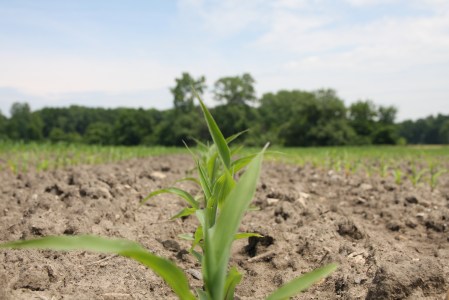
How do we make the best of a “slow” start to the year? I guess I would have to say, “Be prepared for the next step”. I expect that corn plants in many fields are just emerging or at the most, at a V2 stage. Inspect your crop. How many plants emerged? Did you notice how many came up in the first 24 hours, or better yet, 12 hours? Do you have a good stand? If so, what comes next in your management plan? Did you plan on an additional application of nitrogen or a biological or a herbicide application? At what stage of growth? You can approximate the time for corn to develop 2 leaves from now. It takes roughly 84 growing degree units for the next collared leaf to appear. I suggest using the growing degree calculator on georgiaweather.net program at: http://georgiaweather.net/mindex.php?content=calculator&variable=dd&type=dt . Choose the weather station nearest to you in the drop down box, then place the planting date in the “from” box, change the base temperature to 50 degrees, and the disregard temperature above 86 degrees. You are now ready to see how many growing degrees units that have accumulated since you planted your corn by clicking on the “calculate” icon. Play around with it so you can determine the amount of GDU’s (growing degree units) you are accumulating on a daily basis. Separate the “from” icon and “to” icon by one, two and three days and look at how many hours accumulate. Now you are ready to predict when you might reach a certain stage of growth. Around a V10 stage, corn growth rapidly speeds up. On the average, a new collared leaf appears at that time ~ every 56 hours.
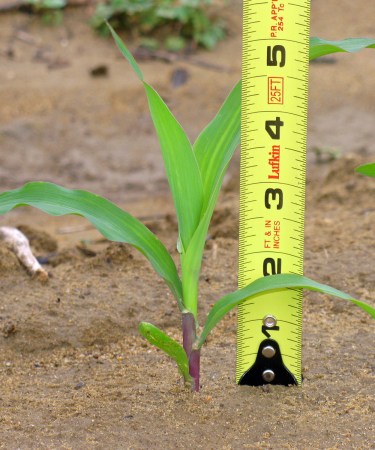
With this knowledge, you can be more precise in repeating good management practices that you see pays better dividends. Dr. Prostko (UGA weed scientist) says that (depending on weed species) your weed control is most effective and efficient when corn nears the V3 to V4 stage. I do see a lot of growers waiting a little longer. I encourage you to act sooner. Also remember, that corn slowly begins to transition to a reproductive state as the fifth, sixth and seventh leaf appears. At that time, all the embryonic cells forming the ears and tassel have developed and the plant will begin rapidly growing. Nutrient deficiencies at this time will reduce the total dry matter and produce a smaller plant that will be less productive.
Let’s use technology to our advantage. Following the crop growth and anticipating your management input helps you to be timely and maybe one day ahead of stress. Use tissue analysis to know how effective your fertilizer program has been up to that point. Watch the nutrients over time to make sure that you stay ahead of any potential deficiency. Its better to catch it before you lose yield and actually be able to supplement it to protect what your are developing.
 Georgia Corn Growers Blog