
Sometimes, it is difficult to step away from all the other things in life that keep you so busy that you don’t do what you need to do. In this case, it is trying to keep you all informed of the corn world. I’ve been fighting this battle. Leo Tolstoy once said “The two most powerful warriors are patience and time”. I been fighting them both. Charles Buxton said ”You will never find time for anything. If you want time, you must make it”. I should have written this long before now. My apologies. I hope to get some of the last month summarized for you.
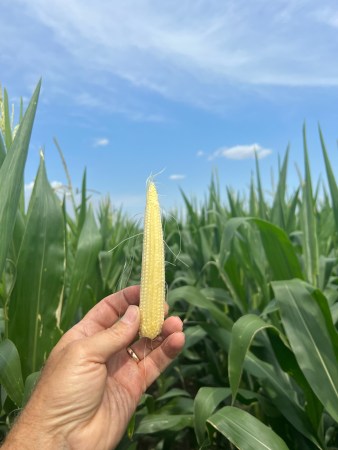
During this time, I have visited lots of corn fields and looked at plants, seen some problems, offered suggestions, and observed the largest separation of planting dates that I can remember. Georgia corn was planted from late February thru March to early May. This alone makes it difficult to fight problems, particularly at a 10,000-foot view that I have. So, I had a conversation with Mr. Rome Ethredge (former Seminole Co. Extension Agent and Agronomist and Crop Advisor) this morning. He reminded me that some of his grower’s corn field were in the dent stage. We talked about southern rust, stink bugs and other problems. Fields that I have visited over the last week ranged from V-11 to R2. Recommendations are much more difficult with this type of corn crop (V-11 to R-5).

One problem that I feared would show up is southern corn rust. Early this week, it was found in Florida and could, by now, be around the southern counties of Georgia. The weather is favorable for its establishment. Other diseases that were spotted over the past several weeks (northern corn leaf blight and spot and common rust) were not widespread but can always pose a problem. Please stay on the look-out for southern rust. In my discussions with Rome, I agreed with him that corn in a R-5 (dent stage) should not be sprayed for s. rust particularly if you had already sprayed, say three weeks ago. However, if you have corn in a R-4 stage (dough) or earlier, I would spray, particularly, if you hear or see and confirm it nearby. Please keep scouting.
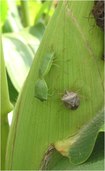
Another problem that can be detrimental are stink bugs infestations. Their population is on the rise again and therefore, I would include an insecticide with the fungicide if I had to spray for a disease. Stink bugs can be a HUGE problem for corn that is just silking or at R-1 stage. I would add a fungicide if your crop is R-4 or earlier and you were spraying for the insect. Another insect problem that I am seeing in the central and northern areas are Japanese and spotted cucumber beetles (southern root worms). They can be a problem so I would encourage spraying for those particularly if your corn hasn’t reach silking. Japanese beetles can easily cut silks and significantly reduce pollination. Please consult your county Extension agent and/or your consultant for fungicide and insecticide recommendations. Protect your crop from these problems.
Totally, switching gears…..I can gladly say that Georgia Corn Growers Association and all the other state corn association along with the National Corn Growers are celebrating that the U.S. Trade Representative (USTR) finally moved to file a dispute settlement under the U.S.-Mexico-Canada Agreement (USMCA) to force Mexico to back away from their ban of U.S. corn. Mexico’s ban is not based on science and risk-based policies at all. This is a step to ensure free and open trade with one of our largest trading partners and ensure that all corn can continue to utilize technologies to meet the sustainable food, feed, and fuel needs of our trading partners.

Under USMCA, once a dispute settlement is filed, a group of objective experts will be empaneled to hear the case and make final determinations based on the commitments both parties signed as part of the free trade agreement. We still have a long fight ahead of us but now there are time tables set up to settle this dispute.
Another win for us occurred a couple of weeks ago. The U.S Supreme Court narrowed the scope of the Clean Water Act’s jurisdiction by clearly rejecting the vague “significant nexus test”. This stopped the Biden’s administration’s overreaching Waters of the United States (WOTUS) rule change. It was the majority’s opinion that significantly narrowed the definition of adjacent wetlands, saying that to be adjacent and therefore a WOTUS, the wetland must have a continuous surface connection to a relatively permanent body of water connected to a traditional navigable water. We have a lot of very small bodies of water that could be classified under the now, former ruling. Thank you, Supreme Court.
If you are not a member of the Georgia Corn Growers Association and want to support your grower members, feel free to send me a note at deweylee@uga.edu. I’ll help you get signed up.
 Georgia Corn Growers Blog